Outline
For the Circular annulus case we know the closed form solution for the evolution for the single point vortex dynamics so we can verify our mechanics for that case.
Exterior Calculus Derivation
#TODO
Analytical Derivation for Harmonic Part
For a circular annulus
A = { x ∈ R 2 : a < ∣ x ∣ < b } A = \{ x \in \mathbb{R}^{2} : a < \lvert x \rvert\ < b \} A = { x ∈ R 2 : a < ∣ x ∣ < b } with one point vortex on the plane represented as:
x ( t ) = r ( t ) e i θ ( t ) x(t) = r(t)\,e^{i\theta(t)} x ( t ) = r ( t ) e i θ ( t ) where a < r ( t ) < b a < r(t) < b a < r ( t ) < b θ ( t ) \theta(t) θ ( t )
For an annulus, we can think of the stream function coming from an imaginary point vortex kept at the center of the annulus. We don’t know the strength for. For such point vortex, the stream function is given as:
ψ h = Γ 2 π log r + C ⟹ A log r + C \psi_{h} = \frac{\Gamma}{2\pi}\log r\,+\,C \implies A\log r + C ψ h = 2 π Γ log r + C ⟹ A log r + C where A A A C C C
A log r i n + C = 1 A\log r_{in} + C = 1 A log r in + C = 1 A log r o u t + C = 0 A\log r_{out} + C = 0 A log r o u t + C = 0 A log r i n − A log r o u t = 1 A\log r_{in} - A\log r_{out} = 1 A log r in − A log r o u t = 1 A = 1 log ( r i n / r o u t ) A = \frac{1}{\log\left( r_{in}/r_{out} \right)} A = log ( r in / r o u t ) 1 C = log ( r o u t ) log ( r i n / r o u t ) C = \frac{\log(r_{out})}{\log(r_{in}/r_{out})} C = log ( r in / r o u t ) log ( r o u t ) ∴ ψ h = log ( r / r o u t ) log ( r i n / r o u t ) \therefore \boxed{\psi_{h}= \frac{\log(r/r_{out})}{\log(r_{in}/r_{out})}} ∴ ψ h = log ( r in / r o u t ) log ( r / r o u t ) Then,
∇ ψ h = 1 log ( r i n / r o u t ) 1 r e r \nabla \psi_{h} = \frac{1}{\log(r_{in}/r_{out})} \frac{1}{r} \mathbf{e}_{r} ∇ ψ h = log ( r in / r o u t ) 1 r 1 e r Also, J e r = e θ J\mathbf{e}_{r}=\mathbf{e_{\theta}} J e r = e θ
∴ J ∇ ψ h ( r ) = u h ( r ) = 1 r log ( r i n / r o u t ) e θ \therefore J\nabla \psi_{h}(r) = \boxed{u_{h}(r)= \frac{1}{r\log(r_{in}/r_{out})} \mathbf{e_{\theta}}} ∴ J ∇ ψ h ( r ) = u h ( r ) = r log ( r in / r o u t ) 1 e θ taking circulation around a loop around the center hole of the annulus:
κ = ∮ γ u h ( r ) ⋅ d l \kappa = \oint_{\gamma}u_{h}(r) \cdot dl κ = ∮ γ u h ( r ) ⋅ d l d l ⃗ = r d θ e θ d\vec{l} = r\,d\theta\,\mathbf{e_{\theta}} d l = r d θ e θ
κ = ∮ y 1 r log ( r i n / r o u t ) r d θ ⟹ κ = 2 π log ( r i n / r o u t ) \kappa = \oint_{y} \frac{1}{r\log(r_{in}/r_{out})} r\,d\theta \implies \boxed{\kappa = \frac{2\pi}{\log(r_{in}/r_{out})}} κ = ∮ y r log ( r in / r o u t ) 1 r d θ ⟹ κ = log ( r in / r o u t ) 2 π Analytical Derivation of Co-Exact Part
z = r e i θ → log ( z ) → w = x + i y → log r + i θ → z = r e^{i\theta} \to \log(z) \to w = x + i y \to \log r + i\theta\to z = r e i θ → log ( z ) → w = x + i y → log r + i θ → circle r → R → line x = log R \text{circle}\,r \to R \to \text{line}\,x = \log R circle r → R → line x = log R r ↦ R 2 r → x ↦ 2 log R − x r \mapsto \frac{R^{2}}{r} \to x \mapsto 2\log R - x r ↦ r R 2 → x ↦ 2 log R − x This log transformation makes the inversion as just a plane mirror reflection.
https://chatgpt.com/share/69eecc63-23dc-83e8-a5e2-3f1ab9f3f6b2
Generating Lattice from images by the conformal map.
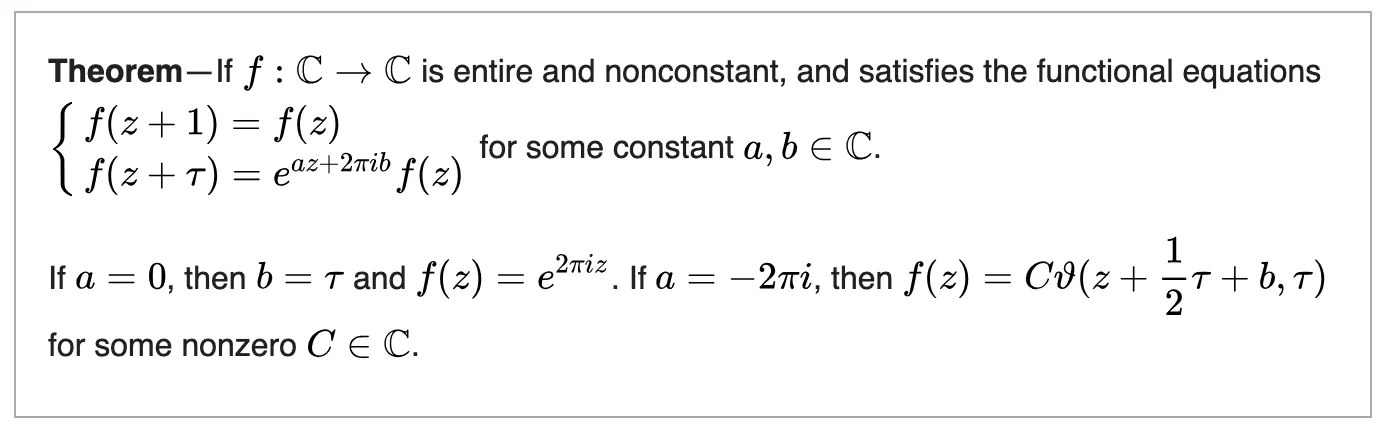
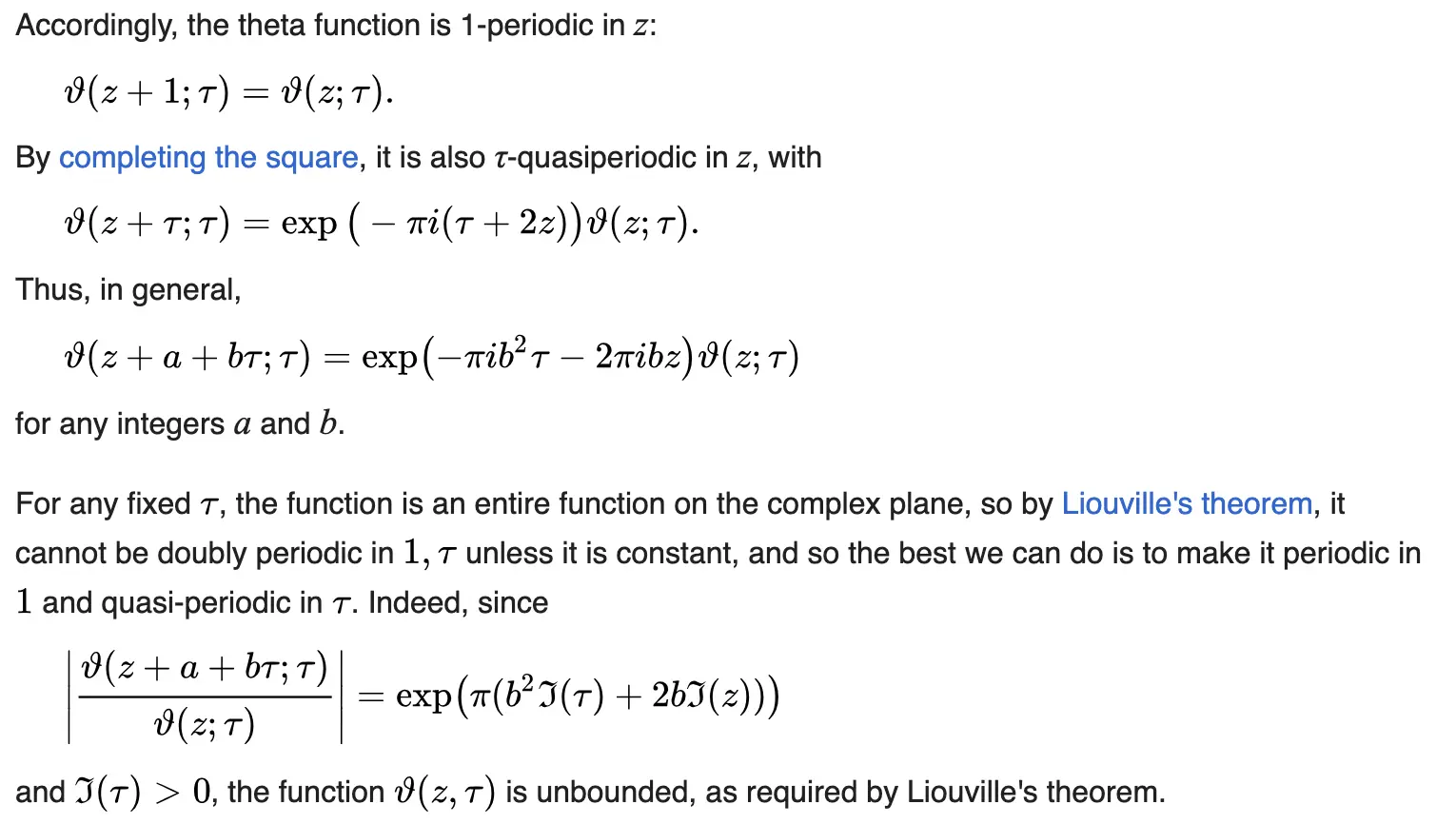
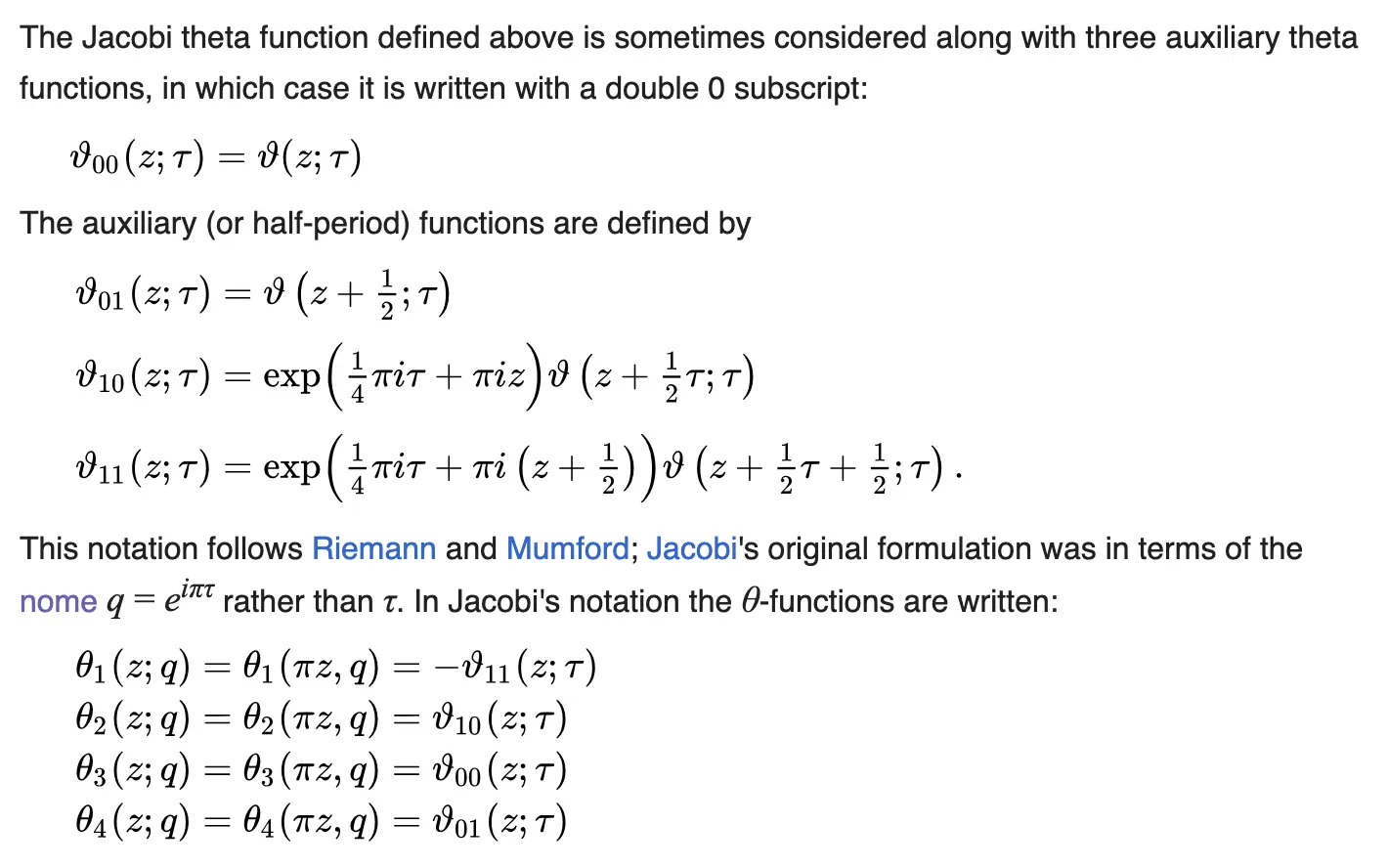
Finding a theta function
Stream function from complex potential
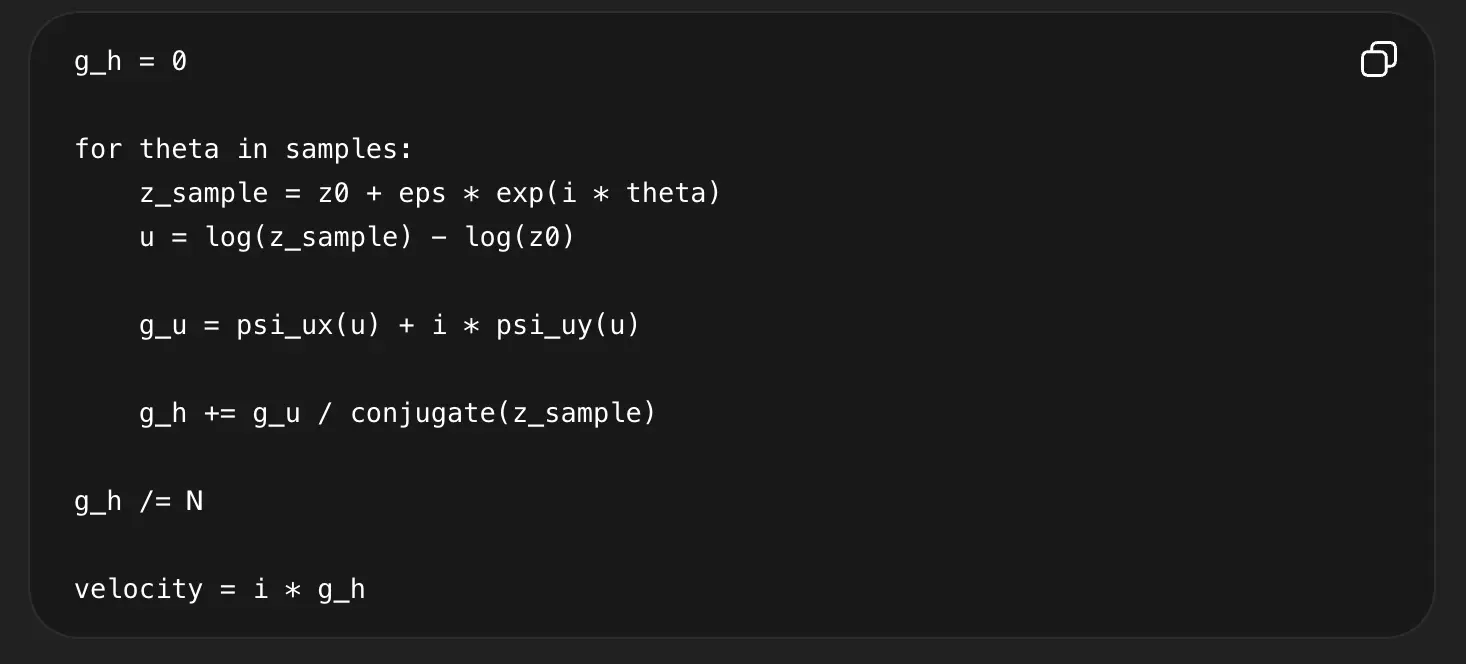
Removing self-singularity using mean value property
Velocity from stream function
Wirtinger Derivatives
Velocity calculation
Simulation Result Analysis
Visualize the stream function - Need anyways
What’s the stream function
Matching stream function values to the Poisson solve case
Today:
Velocity visualization away from vortex
Velocity at the core comparison DEC vs analytical case.
Stream-function values at the boundary.
Validations
Rotational In-variance: Velocity constant for R no change over θ \theta θ
Trajectory validation:
Written by Rudresh Veerkhare.
Older: Velocity Averaging and Mean Value Property © 2026 Rudresh Veerkhare
 https://chatgpt.com/share/69eecc63-23dc-83e8-a5e2-3f1ab9f3f6b2