Laplacian on closed surface
Spectrum of Laplacian, Compatibility and Uniqueness of Poisson Problem
Spectral Decomposition of the Laplacian
We have a Poisson problem setup as:
where is a Laplacian operator acting on a function in above. The spectral decomposition of talks about functions where:
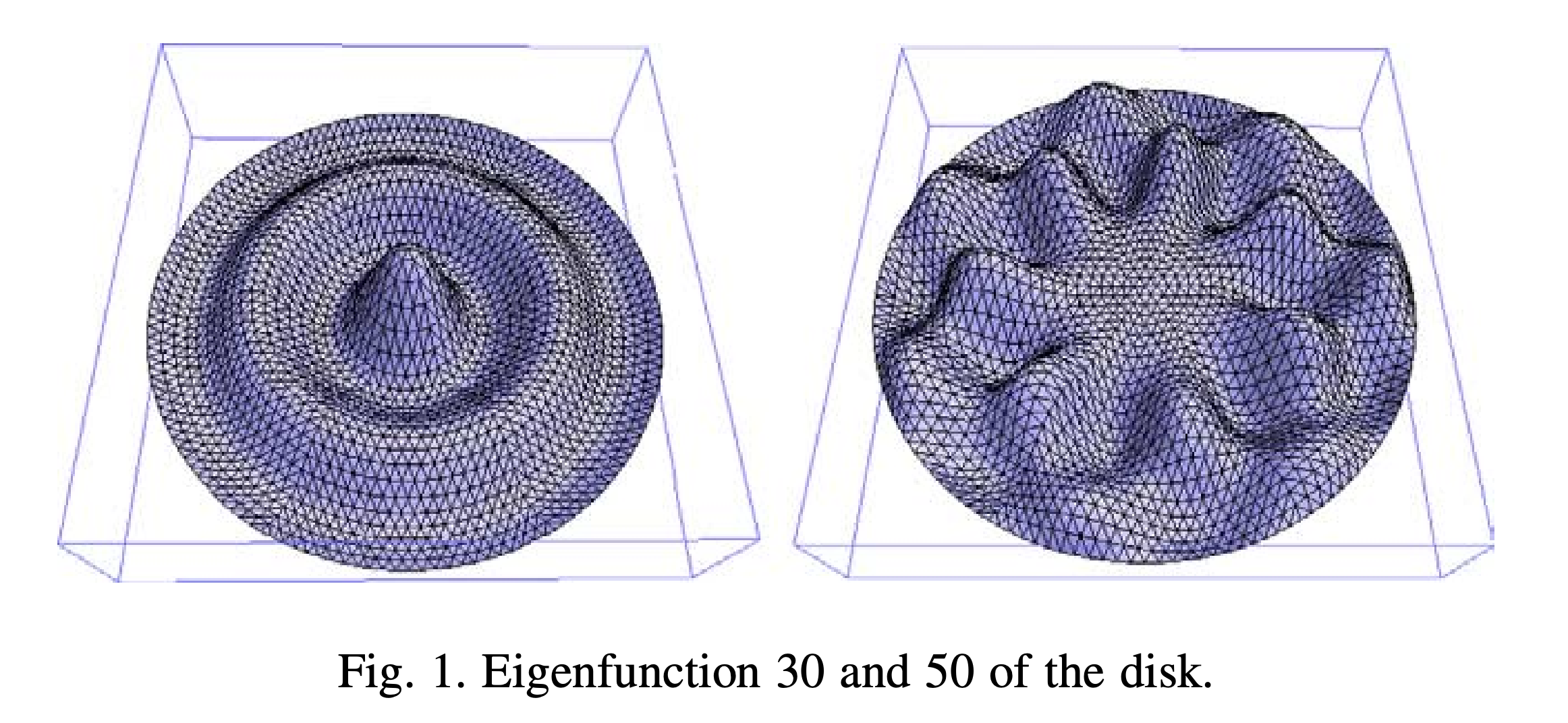
Here the are called as eigenmodes of the operator . These are functions on which the Laplacian acts as a linear scaling by .
Spectral Theorem
This theorem tell us that for a symmetric and self-adjoint operator, there exists real eigenvalues and eigenmodes. These eigenmodes are orthonormal under inner product and its eigenmode spans the entire space i.e., these eigenmodes are basis for the underlying space.
If the eigenvalues are real then we can naturally be ordered:
A few interesting points:
- if then the operator in non-invertable as it has some eigenmode going into the kernel of the operator. Which in-turn makes it non bijective.
- Higher values of belongs to higher oscillatory eigenmodes on the domain.
Laplacian on Closed Surfaces
In our case, we often need to solve Poisson problem on a closed surface where:
Given that is a symmetric and self-adjoint, spectral theorem tells us:
where and are the eigenmodes and eigenvalues. Closed surface have null boundary. So integrating over the closed surface
but on a closed surface. (using integration by parts and then green’s theorem). Which forces a mean zero constrain on RHS for a valid solution to exist for the equation.
Mean-zero constraint only says solution exists but not a unique solution. As constant lies in the kernel of the Laplacian operator , there exists infinite number of solutions for for all constant , as . For unique solution we need to add one more constraint like mean-zero , i.e., to fix a gauge for a unique solution. Numerically, this mean-zero constraint on can be applied by Lagrange multiplier. Or by a Dirichlet pin.
Inverse using Eigenmodes
From spectral theorem we know that eigenmodes are basis for the underlying space. That means we can express both the solution and RHS using these modes as basis.
This give us a neat way of solving the Poisson problem. This also says that else the inverse of doesn’t exist on the whole space. We can still invert it on the subspace orthogonal to the kernel.
© 2026 Rudresh Veerkhare