Regularized Point Vortex Dynamics
Discretization of regularized point vortex dynamics
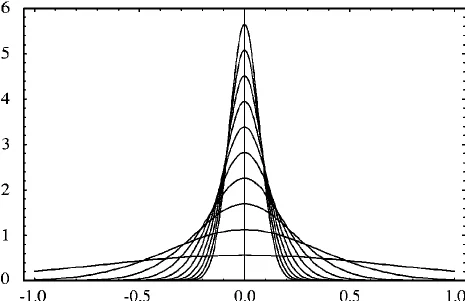
Why Regularize?
The original point vortex dynamics, the point vortices are represented as delta functions . Then, from the in-compressible Eulerian fluid flow, we have a Poisson problem setup as:
The solution for this PDE is given by a Greens function. But this greens function has logarithmic singularities at the point vortex location.
Where is geodesic distance.
The one big issue with is that the energy , which is equivalent to on a surface. As has a log singularity at , the energy is infinite as well. Which also means the Hamiltonian of the system is infinite as well.
Regularized Point Vortex
To solve this issue we define a point vortex as a blob with compact support , now this limits the energy to be finite everywhere. And due to the radial symmetry of the blob, to points outside the core of the blob, the effect is same as of a point vortex to the leading order with error term of .
Let be a closed surface and let be the Green’s function.
A vorticity for a point vortex at a point is defined as:
Now for a regularized point vortex blob:
Non Singular Stream Function
Averaging Green’s function over some area remove the singularity. The greens function has a logarithmic response for a point impulse, we can think of integrating such point impulses over an area. Zooming in around the singularity:
Using polar coordinates around the point, . Then the integral becomes:
and the is finite over small path around origin, which explains why the average of singular greens function over a patch is not singular.
Difference in Point Vortex Vs Regularized Vortex Core
For getting a finite Hamiltonian we can regularize the Point vortex model to have a vorticity spread over a small neighborhood around the point, formally a compact support over a radially symmetrical code with radius . Then the question becomes how does our fluid dynamics is affected by it. This can be quantified by comparing resultant stream functions in both cases.
For point vortex where there’s a point vortex at . For a regularized point vortex we have, .
Now for the regularized blob case we know that there’s no singularity present, i.e., green’s function is smooth near at the location of the point vortex core . Using Taylor’s expansion we can write:
substituting this to get the regularized stream function,
As for a radially symmetrical blob. But then,
Similarly, velocity is , therefore:
Regularized point vortex dynamics is same to the leading order to the actual point vortex dynamics.
Regularization Due to Discretization
When we finally try to implement this continuum model on a discrete mesh we see a new form of regularization added by the coarseness of the mesh. Ideally the vorticity should be only supported on a ball of radius but once due to the splatting of the vortices to the mesh, we spread the actual vorticity on the basis vectors in the Finite Element space.
Spectral Decomposition of the Laplacian
TBD
Taylor expansion of Green’sTells how blob is different from point
- Spectrum of Laplacian -> (eigen)modes of Laplacian -> Inverse using eigenmodes -> Explains smoothing -> adding heat kernel to filter -> Explains heat-kernel smoothing
- Implementation in the discrete case
- Simulation
- Observe Hamiltonian
- Observe error term wrt .
- Complete the report and sent results to Albert!!!
Regularization on continuum-> regularization due to mesh anisotropy -> fix -> implementation
© 2026 Rudresh Veerkhare